

Environmental, Social and Governance (ESG) Report 2025/26
Introduction
Welcome to our 2026 Environmental, Social and Governance (ESG) Report. This report shows how we are responding to a changing social housing sector while staying focused on our purpose: improving customers’ lives by providing healthy and affordable homes and enhancing our communities.
In 2026, housing providers continue to face higher expectations around home quality, safety, consumer regulation, transparency, energy efficiency, the response to damp and mould and broader requirements being introduced this year through the rollout of phase 2 of Awaab’s Law. At the same time, customers are under pressure from the cost of living, and the sector must balance investment in existing homes with the need to provide more social and affordable housing.
For believe housing, ESG is part of how we measure whether we are doing the right thing for our customers, colleagues and business. It supports our Corporate Plan and our vision of life without barriers by bringing together evidence on affordability, customer voice, resident support, climate change, governance, social value, colleague wellbeing and long-term financial sustainability.
Sustainability is central to that work. It means investing in homes that are safe, warm and affordable to run, improving energy efficiency, reducing our environmental impact and making sure our decisions create lasting value in the places we serve.
I am proud of the progress we continue to make, including investment in our homes, new affordable housing, customer support, social value and a positive colleague culture. We also know where we need to improve and we will keep using data, insight and feedback to guide our decisions.
The year ahead will bring further challenge, but our values give us a strong foundation. By listening to customers, supporting colleagues and making sustainable choices for the long term, we can continue to deliver healthy and affordable homes and make a positive difference within communities and across the North East.
Alan Smith
Chief Executive
The year in numbers
Our approach
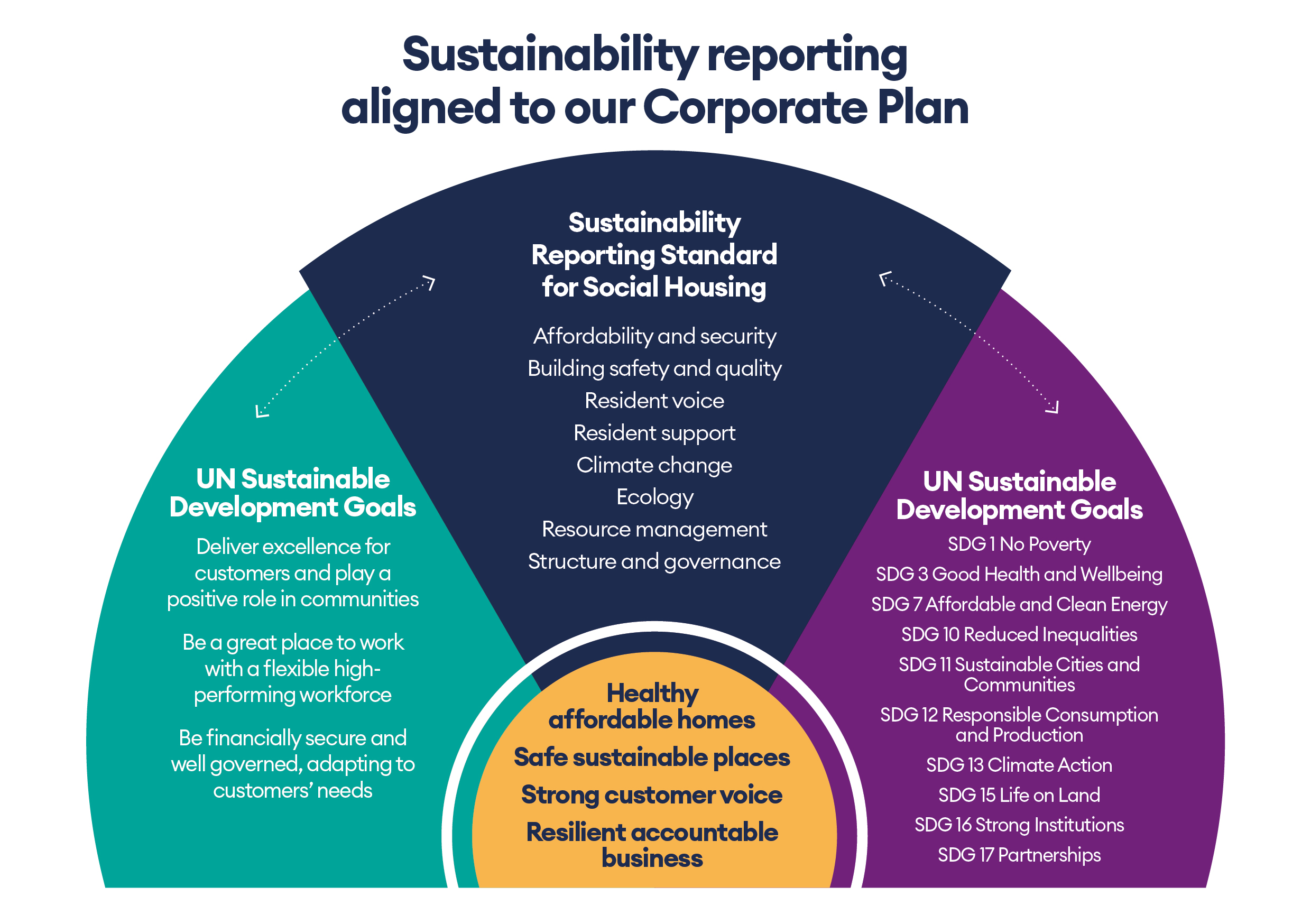
Our Environmental, Social and Governance (ESG) approach is structured around the three pillars that guide our Corporate Plan and Corporate Performance Management Framework: Customer, Colleagues and Business.
This provides a clearer and more connected way to show how we are delivering against the issues that matter most to our customers, our communities, our people and the long-term sustainability of believe housing.
By aligning ESG themes to these three pillars, we can bring together environmental, social and governance information in a way that reflects how the business is managed and how performance is understood. It helps us demonstrate where we are making progress, where we need to improve, and how our decisions support positive outcomes, resilience and long-term value. We also continue to align our reporting to the UN Sustainable Development Goals, recognising the contribution we can make to the wider sustainability agenda.
We also continue to align our reporting to the UN Sustainable Development Goals, recognising the contribution we can make to the wider sustainability agenda.
Corporate Performance Framework
| ESG area | ESG theme | ESG description |
|---|---|---|
| Customer | Affordability and security | Provides affordable and secure homes |
| Resident and community | Listens to and supports residents and local community | |
| Placemaking | Supports residents and the wider local community through placemaking | |
| Business | Climate | Prevents and mitigates the risk of climate change |
| Nature | Promotes ecological stability | |
| Resource management | Sustainable management of natural resources and responsible procurement | |
| Building safety and quality | Resident safety and building quality are well managed | |
| Statutes and Boards | High quality organisational leadership, accountability and oversight | |
| Colleagues | Employees | Supports employees |

Customer

Affordability and security
- We supported 4,540 customers to sustain their tenancy.
- We helped 258 customers to access water grants.
When setting rents, we balance affordability for customers with the income needed to maintain, improve and invest in our homes. Current UK Government policy provides a 10-year social rent settlement from April 2026, with annual increases generally limited to CPI + 1% and a phased rent convergence mechanism for social rent homes below the calculated formula rent. Our rents remain among the lowest in the region, and we will continue to assess the impact of this policy alongside wider household costs to ensure affordability is considered beyond rent alone.
The data below demonstrates our affordability and provision of tenures in the following ways:
- Rent compared to median private rental sector (PRS) rent across the local authority
- Rent compared to Local Housing Allowance (LHA)
- Regional comparator with other registered providers (RP)
- Existing and new provision by tenure type.
The table shows that our rents remain below private rented sector levels across all areas except Hartlepool. The relationship with LHA varies by local authority. However, our rents continue to be lower than LHA in Durham where most of our homes are. Year-on-year, our average rents have increased, while in some areas the proportion of LHA has also risen.
Total stock*
| Local authority | Year | Number of believe housing homes | Overall average believe housing weekly rent | % of LHA rent | % of PRS rent (ONS, n.d.) |
|---|---|---|---|---|---|
| Durham | 2024/25 | 18,100 | £88.55 | 86% | 72% |
| 2025/26 | 18,137 | £91.82 | 89% | 70% | |
| Darlington | 2024/25 | 12 | £136.34 | 121% | 92% |
| 2025/26 | 25 | £139.81 | 124% | 99% | |
| Sunderland | 2024/25 | 88 | £128.49 | 111% | 85% |
| 2025/26 | 98 | £134.23 | 117% | 85% | |
| Stockton | 2024/25 | 80 | £147.55 | 117% | 85% |
| 2025/26 | 86 | £151.28 | 121% | 83% | |
| Hartlepool | 2024/25 | 37 | £138.70 | 110% | 101% |
| 2025/26 | 37 | £142.44 | 113% | 101% |
* Figures based on all tenure types excluding shared ownership.
Demand for our homes continues to be high and the need for affordable housing continues to grow.
While current government rent policy provides greater certainty on future income, landlords also face new requirements through the Minimum Energy Efficiency Standard for social housing and the new Decent Homes Standard.
Uncertainty remains around inflation, borrowing costs, grant funding and the cost of meeting these standards.
We will continue to balance customer affordability with the investment needed to maintain, improve and grow our homes, while keeping our long-term plans financially sustainable.
The tables below show the breakdown of existing and new homes by tenure type.
Existing homes (homes completed before the last financial year)
| Timeframe | General needs (social rent) | Intermediate rent | Affordable rent | Supported housing | Housing for older people | Low-cost home ownership | Care homes | Private rented sector |
|---|---|---|---|---|---|---|---|---|
| 2021/22 | 17,556 | 232 | 289 | - | - | 3 | - | - |
| 97.10% | 1.28% | 1.60% | - | - | 0.02% | - | - | |
| 2022/23 | 17,348 | 244 | 349 | - | - | 3 | - | - |
| 96.68% | 1.36% | 1.94% | - | - | 0.02% | - | - | |
| 2023/24 | 17,265 | 281 | 407 | - | - | 10 | - | - |
| 96.11% | 1.56% | 2.27% | - | - | 0.06% | - | - | |
| 2024/25 | 17,221 | 394 | 495 | - | - | 16 | - | - |
| 95.01% | 2.17% | 2.73% | - | - | 0.09% | - | - | |
| 2025/26 | 17,107 | 450 | 640 | - | - | 22 | - | - |
| 93.90% | 2.47% | 3.51% | - | - | 0.12% | - | - |
New homes (homes completed during the last financial year)
| New homes (homes completed during the last financial year) | General needs (social rent) | Intermediate rent | Affordable rent | Supported housing | Housing for older people | Low-cost home ownership | Care homes | Private rented sector |
|---|---|---|---|---|---|---|---|---|
| 2021/22 | - | 12 | 60 | - | - | - | - | - |
| - | 16.67% | 83.33% | - | - | - | - | - | |
| 2022/23 | - | 35 | 58 | - | - | 7 | - | - |
| - | 35.00% | 58.00% | - | - | 7.00% | - | - | |
| 2023/24 | - | 113 | 89 | - | - | 6 | - | - |
| - | 54.33% | 42.79% | - | - | 2.88% | - | - | |
| 2024/25 | - | 63 | 144 | - | - | 1 | - | - |
| - | 30.29% | 69.23% | - | - | 0.48% | - | - | |
| 2025/26 | 11 | 58 | 117 | - | - | 8 | - | - |
| 5.67% | 29.90% | 60.31% | - | - | 4.12% | - | - |
The table below shows how our average social rents compared to our regional competitors in the last financial reported year 2024/25[1]:
[1] Registered provider social housing stock and rents in England 2024 to 2025 – GOV.UK
Our regional competitors
| believe housing | Livin | Karbon | Bernicia | Gentoo | Thirteen | North Star | Beyond | |
|---|---|---|---|---|---|---|---|---|
| Non-self-contained | £0.00 | £0.00 | £95.14 | £0.00 | £0.00 | £79.81 | £0.00 | £0.00 |
| Bedsit | £68.33 | £74.90 | £78.97 | £77.65 | £0.00 | £79.09 | £83.73 | £80.45 |
| 1 Bedroom | £77.43 | £83.58 | £84.93 | £84.06 | £85.38 | £90.84 | £89.44 | £93.78 |
| 2 Bedroom | £86.25 | £93.82 | £94.28 | £92.70 | £96.27 | £102.35 | £103.88 | £105.82 |
| 3 Bedroom | £93.91 | £101.33 | £103.21 | £102.19 | £105.84 | £111.53 | £114.36 | £115.80 |
| 4 Bedroom | £100.78 | £109.51 | £119.31 | £114.89 | £115.88 | £121.36 | £131.19 | £126.52 |
| 5 Bedroom | £105.63 | £120.90 | £134.50 | £111.09 | £123.74 | £132.16 | £135.29 | £136.92 |
| 6+ Bedroom | £142.91 | £0.00 | £148.23 | £0.00 | £146.32 | £141.31 | £141.16 | £142.83 |
| Average | £86.42 | £94.64 | £95.03 | £95.22 | £97.68 | £103.84 | £105.19 | £106.66 |
Fuel poverty
• £20,386 heat and eat vouchers issued
Fuel poverty remains a central government priority.
The 2026 Fuel Poverty Strategy for England sits alongside the Warm Homes Plan, with a continued focus on improving low-income, energy-inefficient homes to EPC band C where reasonably practicable by 2030.
The government has also committed major investment through the Warm Homes Plan, including support for low-income households and social housing retrofit, to reduce or limit energy bills, improve health outcomes and support the transition to warmer, safer and more energy-efficient homes.
This policy direction is closely linked to proposed Minimum Energy Efficiency Standards for social housing and wider Decent Homes reforms. It increases the focus on improving the fabric and performance of existing homes, while recognising the scale and cost of delivery. Our improvement programme responds to this by combining energy efficiency measures, smart technology and building fabric works, supported where possible by external funding such as the Warm Homes: Social Housing Fund.
We also work with Durham County Council and other partners to identify households experiencing fuel poverty or financial difficulty, and help customers maximise income and to access grants, advice and practical support.
And customer-facing campaigns, including social media messages, raise awareness of the support that is available. This has included highlighting the impact of small changes they can make, sharing energy-saving tips and signposting customers to help with heating costs, benefits, grants, safer borrowing and support from our Money Matters Team.





Resident support
- £2.3m in welfare benefit gains for customers
- 818 customers received support and reduced their arrears
- We helped customers manage £361,892 of debt
- 78% of customers referred to our Tenancy Sustainment Team engaged with the service
- 252 adult safeguarding referrals
- 68 children’s safeguarding referrals
- 311 domestic abuse referrals
- 161 multi-agency safeguarding hub (MASH) enquiries
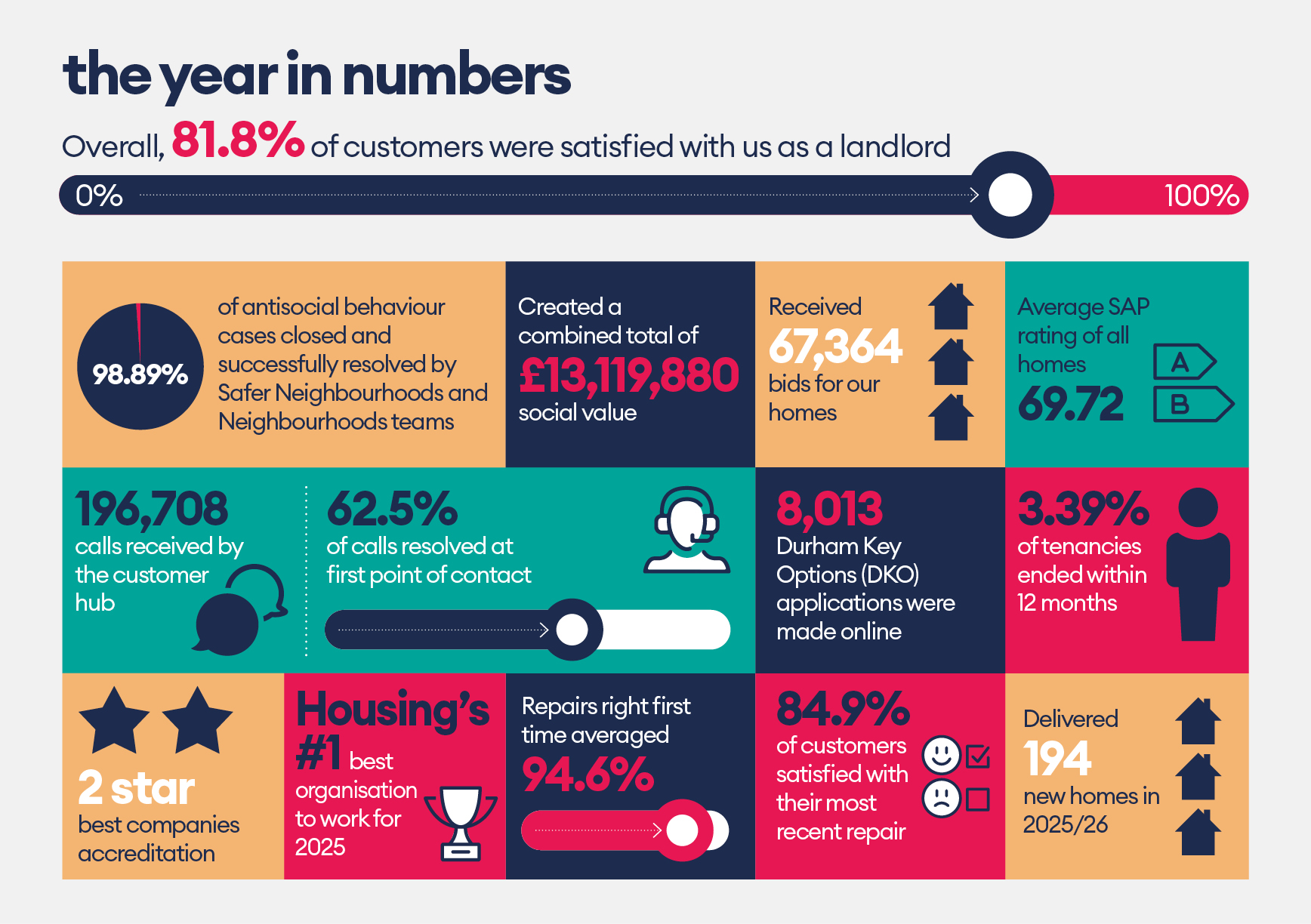
- 62.5% of calls resolved at first point of contact
- 136 customers helped into work
- 149 customers helped to access training opportunities
We use a triaged approach to tenancy management, starting when people apply for one of our homes. Where support needs are identified, we work with customers before their tenancy begins to help them build the skills and support networks needed to manage their home and sustain their tenancy. This enables us to focus resources where they are needed most and provide support tailored to each customer’s circumstances.
We also support customers who experience difficulties after moving into their home, with a focus on helping them sustain their tenancy. This can include support with rent payments, access to grants and charitable organisations, benefit maximisation, and referrals to help customers move into better-paid, sustainable employment.
Each year, we take part in national Money Talks Week, working with colleagues across the business to visit customers in their communities and offer advice and support. The campaign raises awareness of the help available to people experiencing financial difficulty and complements our work with Stop Loan Sharks, which supports victims of illegal money lending.
Together, our Employability, Income Recovery, Lettings, and Neighbourhoods teams worked with 4,540 customers to help them sustain their tenancies, maintaining low levels of customers terminating their tenancy (3.39%) as well as obtaining £2.3m in financial gains. This also gave us a social value return of £4.4m where we have reduced arrears for our customers.
Our Employability Team supports our customers to enter the jobs market and access better paid sustainable employment. In the last financial year, we supported 136 people into sustainable employment.
Reflecting increased regulatory focus on transparency and our commitment to doing the right thing, our community investment programme continues to be overseen by a customer-led panel that awards grants of up to £100. We have supported panel members with the training and development needed to assess applications against agreed objectives. In 2025/26, the panel awarded 105 grants, contributing £11,755,726 in social value for our customers.
We focused our investment on key areas that create the biggest impact, including:
- health and wellbeing, supporting mental and physical health, and building confidence
- employability and training, including volunteering and skill-building activities
- increasing household income, through debt advice, benefits support, feeding families, and employment
- a greener, fairer future, promoting recycling, reusing, and reducing waste
- tackling inequalities from the cost-of-living crisis, including ‘Keep Warm, Keep Well’ grants for community organisations running warm hubs.
In 2025/26, our community investment funding:
- supported 138 people to become regular volunteers
- provided 474 people with training
- helped 90 young people to feel more confident
- supported 595 people to improve their diet
- supported 74 people to feel a sense of belonging in their neighbourhood
- empowered 51 people to take up regular exercise.
Case study: Talking Money at Peterlee employability event
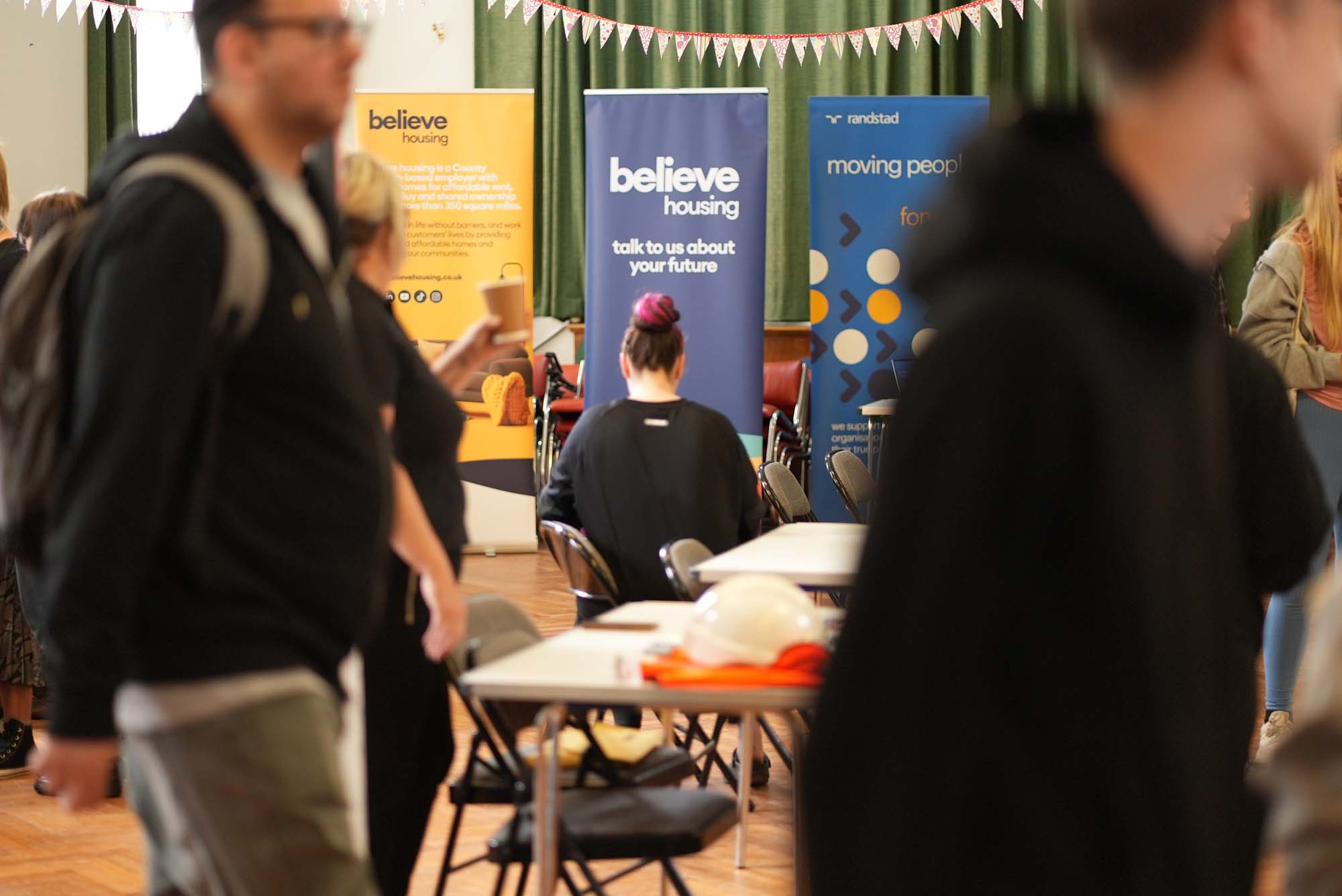
The Tenancy Sustainment and Money Matters Teams attended the Peterlee Employability Event, hosted by believe housing’s Employability Service as part of the Talking Money campaign. The event brought customers, local residents and partner organisations together to provide practical support on employment, money and housing.
The teams offered early advice to help people understand how moving into work or changing employment circumstances could affect income, benefits and housing costs.
Working with partners including Durham County Council, DWP, NE First Credit Union and East Durham College, the teams provided advice and signposting on employment support, Discretionary Housing Payments, Durham Key Options, income maximisation and Universal Credit.
The event enabled practical conversations about budgeting for work and reporting changes through Universal Credit journals, helping attendees understand what action they may need to take.
A key outcome was supporting a customer to make a successful Discretionary Housing Payment application through collaboration between the Money Matters and Employability Teams. One attendee also expressed interest in joining believe housing’s Board.
The event demonstrated the value of taking advice into community settings, strengthening local partnerships and helping people move towards employment and financial stability.


Resident voice
- 74.2% of our customers believe we listen and act on their views
- 78.0% of our customers believe we keep them informed about things that matter to them
- 86.2% of our customers feel we treat them fairly and with respect
- 36.5% of customers reported being satisfied with how we handled their complaint
- 84.9% of our customers were satisfied with our repairs service
- 81.2% of our customers were satisfied with the time taken to complete their most recent repair
- 65.0% of our customers were satisfied with our approach to antisocial behaviour
- 9 people supported to become regular volunteers
Our Engagement Team gathered customer feedback through face-to-face focus groups with 41 customers, 2 community events and 4,388 survey responses.
Engaging with customers
We continue to explore ways to involve as many customers as possible in decision-making, including through our Customer Complaints Panel, which supports fair and transparent complaint handling. Our Customer Voices group also scrutinises key services, carrying out detailed reviews and making recommendations for improvement.
As we continue to put customer voice at the heart of service delivery, we have reviewed and refreshed our customer strategy, shaping our vision for customer experience. We will use Tenant Satisfaction Measures, customer feedback and wider insight to inform this work, while exploring how new technology can support better engagement and service improvement over the coming years.
Our TSMs were carried out quarterly for the first time, and we received 1,163 responses from 17,831 residents.
We carry out regular work to benchmark sector trends and compare our scores with other providers. Our scores are provided in the table below:
Overall satisfaction
| 2020/21 | 2021/22 | 2022/23 | 2023/24 | 2024/25 | 2025/26 |
| 86.8% | 80.0% | 78.5% | 81.4% | 78.1% | 81.8% |
The table shows that overall satisfaction has fluctuated over the last six years. After falling from 86.8% in 2020/21 to 78.1% in 2024/25, satisfaction increased to 81.8% in 2025/26. This recovery is encouraging and remains above the Housemark median of 74.2%.
It also reflects the change in collection methodology both at believe housing and across the sector. We will continue to monitor the impact of our survey methodology, including online responses, alongside wider customer insight to understand what is driving satisfaction and where further improvement is needed.
We are reviewing our engagement approach and are developing a new engagement strategy to further develop the customer insight we are providing the business and to support the Consumer Standards, particularly the expectations around transparency, influence, accountability and customer voice. Over the past six months, we have moved transactional surveys fully online, giving us faster access to feedback, stronger trend analysis and clearer insight into what matters to customers. This helps us target engagement more effectively, evidence how customer views inform decisions, and improve services in a way that is transparent, inclusive and shaped by customer experience.
We are also strengthening how we learn from complaints to improve our service delivery and in line with the Housing Ombudsman’s Complaint Handling Code and the regulatory expectation that complaints are handled fairly, effectively and promptly. Over the past two years, we have introduced a clearer approach to embedding learning and developed additional training for colleagues. This supports a positive complaints culture, helps staff understand their responsibilities, and aims to ensure that learning from complaints is used to put things right, reduce repeat issues and improve the customer experience.
We have a dedicated Board member responsible for complaints, helping to strengthen accountability across the organisation. We have also established a Customer Complaints Panel to review our approach and provide independent customer scrutiny of the service and outcomes from complaints. The panel supports compliance with the Complaint Handling Code, reviews complaints performance, Housing Ombudsman determinations and improvement actions, and contributes to policy reviews and the annual complaints self-assessment. Members remain highly engaged and have completed training to strengthen their understanding of complaints, regulation and tenant satisfaction. The panel will continue to monitor progress and provide customer assurance on complaint handling performance.
In the past year, we received five Housing Ombudsman determinations. We review each determination in detail and use trend analysis to identify learning and improvement opportunities.
Our complaints performance continues to improve. By the end of 2025/26, we responded to 94.2% of stage 1 and stage 2 complaints within the Housing Ombudsman’s timescales, an increase of 0.4% on the previous year. Our response time for stage 1 and stage 2 complaints was an average of 9.02 working days.
Placemaking
- 71.9% of our customers believe we make a positive contribution to their neighbourhood
- 98.6% of our new-build customers are likely to recommend us to a friend
- We delivered 194 new homes in 2025/26
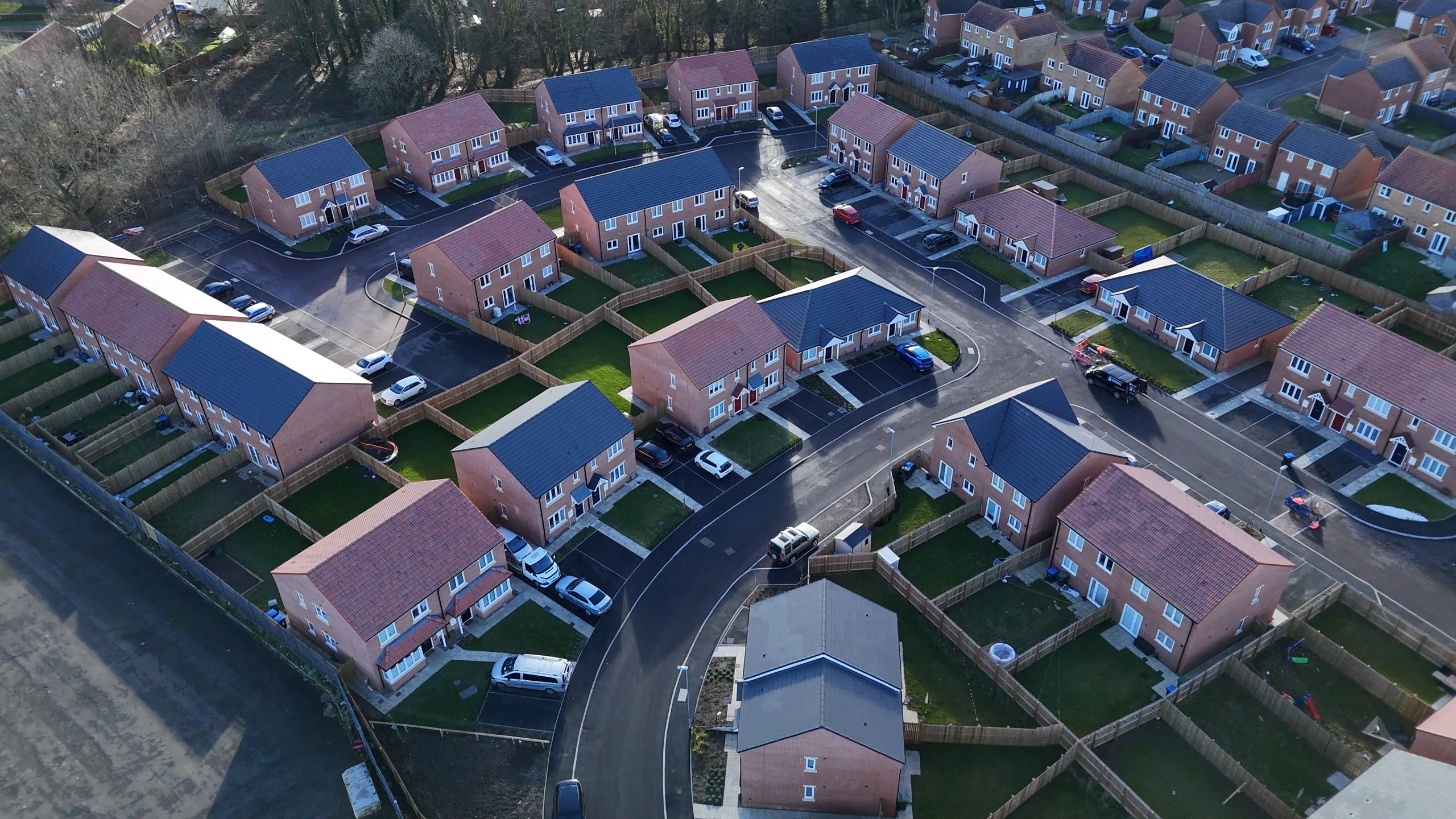
We are committed to creating places where communities can thrive.
Through place-based delivery, we have provided homes across rural and urban areas.
We are developing an Asset and Place Strategy that will bring together services from across the business, with a stronger focus on place, better outcomes for customers and greater impact in our communities. With renewed government focus on affordable housing, we continue to work towards delivering 250 homes each year and building a sustainable pipeline of high-quality homes.
Our work in Brandon and at Farnham Road, where we have planning permission to bring former housing sites back into use by delivering a total of 112 social and affordable homes, demonstrates our commitment to regeneration, listening to communities and tailoring delivery to local needs.
Case study: regenerating brownfield land to deliver affordable homes and stronger communities
Weavers Close in Peterlee, County Durham, has transformed a once-derelict brownfield site off Stephenson Road into a new affordable housing community. Our £9.8m scheme has created 59 affordable homes and is now complete and fully occupied.
The site had stood empty for several years, representing an opportunity to bring unused land back into productive use while responding to significant local demand for affordable housing. Demand for the new homes was strong, with 157 bids received for the 26 homes for affordable rent and more than 650 people registering interest in the 33 Rent to Buy properties.
We worked with Durham-based homebuilder Partner Construction to regenerate the brownfield site and deliver a mixed-tenure affordable housing scheme. The development provides both affordable rent and Rent to Buy homes, supporting residents with different housing needs and aspirations.
The scheme is already making a positive difference to residents’ lives. One resident described how moving into her new home had improved both her own wellbeing and her daughter’s health: “My daughter has chronic illnesses, and I suffer really badly with PTSD, anxiety and depression. Our new home is just perfect; it’s taken a burden off our minds and we’re both feeling so much better. It’s exactly what we needed.”
Business

Climate change
- Average efficiency of our homes is 69.7
- £29.5m spent on improving existing homes
- £30.1m spent on repairing and maintaining customers’ homes
- £45.2m spent on acquiring and developing new homes
- £26.2m spent on wages and salary – employing more than 600 colleagues across the North East
- £7.2m spent on making homes warmer and more efficient
- £772,000 spent on adapting existing homes to meet the needs of customers
Government policy places renewed emphasis on warm, safe and affordable-to-run homes. The 2026 Fuel Poverty Strategy and Warm Homes Plan aim to cut energy bills, improve low-income and energy-inefficient homes, and support the transition to lower-carbon housing, with significant public investment available for home upgrades. Proposed Minimum Energy Efficiency Standards for social housing and wider Decent Homes reforms will increase expectations on the energy performance, safety and quality of existing homes.
We are continuing to assess the financial viability and delivery implications of improving our stock, while working with partners to access funding and grants so that investment can be planned strategically and delivered at scale.
The tables below show how our EPC rating for both existing and new homes have improved year on year:
Existing homes
| EPC rating | Percentage of homes | ||||
|---|---|---|---|---|---|
| 2021/22 | 2022/23 | 2023/24 | 2024/25 | 2025/26 | |
| A | 0.02% | 0.2% | 0.2% | 0.3% | 0.4% |
| B | 3.5% | 4.2% | 5.6% | 5.7% | 4.2% |
| C | 35.5% | 48.7% | 50.5% | 56.3% | 56.3% |
| D | 61.0% | 46.4% | 42.6% | 36.7% | 37.9% |
| E or less | - | - | 1.0% | 1.0% | 1.2% |
| No EPC | - | - | 0.01% | 0.0% | 0.0% |
New homes
| EPC rating | Percentage of homes | ||
|---|---|---|---|
| 2023/24 | 2024/25 | 2025/26 | |
| A | 15.20% | 14.4% | 24.0% |
| B | 81.5% | 60.4% | 66.2% |
| C | 3.3% | 25.2% | 9.8% |
| D | - | - | - |
| E or less | - | - | - |
| * The average SAP rating for our new build homes is 86.43 | |||
We have improved thermal efficiency through the delivery of investment programmes to more than 1,000 properties, mostly using funding from Department of Energy Security and Net Zero’s (DESNZ) Warm Homes: Social Housing Fund Wave Three to complete works, alongside the installation of solar PV panels to 325 homes.
As part of being an ambitious business when it comes to our environmental impact, we are measuring scope 1 and 2 emissions, as those are the ones we are directly responsible for. We do not currently report on the emissions associated with our homes. This metric continues to be reported as part of our corporate performance to give oversight to our Executive Management Team and our Board, all of whom are driving our environmental ambitions as a business. We have also published our emissions on our website to be transparent with our customers on how we are performing. We feel this is important and necessary as part of our role in raising awareness of the climate change agenda.
The table below shows our carbon emissions:
Carbon emissions
| 2025/26 | |
| Scope 1: tonnes CO2 equivalent (tco2e) | 709.52 |
| Scope 2: tonnes CO2 equivalent (tco2e) | 74.30 |
| Scope 1 and 2: tonnes CO2 equivalent (tco2e) | 783.83 |
Nature
As a business, we consider our impact on the environment around us. We focus on a sense of place and creating healthy homes. We have policies and procedures in place to manage hazards and pollutants in customers’ homes, including damp and mould, and we review these regularly.
The new Awaab’s Law requirements, introduced for social landlords from October 2025, set fixed timescales for addressing emergency hazards and significant damp and mould risks. We are strengthening our approach, so concerns are identified, assessed, communicated and resolved promptly, while preparing for the phased expansion of the law to cover further housing health and safety hazards.
Our wider approach includes preventative action, such as removing lead pipework at void stage, to reduce potential pollutants and support safer, healthier homes.


Supply chain management
We use the National TOMs framework to embed social value in procurement. Through our involvement in the County Durham Pound project, we also apply locally developed TOMs measures for County Durham, including environmental measures such as carbon reduction and diverting hard-to-recycle waste away from landfill and incineration.
Supply chain risks are monitored throughout the contract lifecycle. We identify risks during procurement planning and review them through contract management meetings after award. Where relevant, tender specifications include sustainability requirements and environmental expectations. For example, our Voids Works Framework includes the following requirement: ‘All materials must be ethically sourced and procured in line with recognised sustainability and responsible sourcing standards. Timber and timber-based products must come from independently certified sustainable sources, such as the Forest Stewardship Council (FSC).’
Social value is considered in all believe housing procurement activity, with a minimum weighting of 10% of the total evaluation score. To date, our contracts have delivered £722,193.08 in social value.
We have again been recognised as partners of the County Durham Pound for the Best Collaborative Procurement Award at an awards ceremony in Liverpool in May. The County Durham Pound also received Highly Commended in the category for the Social Value Award.
Case study: responsible supply chains through collaborative procurement
believe housing is working with seven other North East Housing Partnership members, Prosper and JTC Furniture to use collective buying power to deliver kitchen replacements more efficiently, sustainably and locally. By aligning specifications and pooling demand across eight landlords, the partnership is reducing duplication, improving value for money and giving suppliers the certainty to invest in local capacity.
The approach is strengthening responsible procurement by creating a more consistent and resilient supply chain, while supporting local economic value through JTC’s new 10,000 sq. ft. assembly and distribution centre in Cramlington. It is also creating social value, with eight employment opportunities already delivered and more forecast as volumes grow. Environmental benefits are being built into the model too, with Timberpak collecting and recycling end-of-life kitchens and wood waste to support a more circular approach.
Over ten years, the collaboration is expected to save more than £10 million through standardised specifications and more efficient waste disposal, while strengthening the regional supply chain and reducing environmental impact.
Building safety and quality
- 84.9% of customers feel their home is safe
- 80.4% of customers feel their home is well-maintained
- 90.0% of homes had a Decent Homes survey in the last five years
We take a proactive approach to compliance and customer safety. We continue to strengthen oversight of home safety, quality and compliance in line with the Regulator of Social Housing’s Consumer Standards and the changing legislative framework for social housing. Compliance is monitored through our corporate scorecard, health and safety reporting and regular assurance to Board and committees.
Our approach is informed by the Safety and Quality Standard, Awaab’s Law, the Decent Homes Standard and the Housing Health and Safety Rating System (HHSRS), with a focus on accurate stock condition data, timely repairs, effective management of hazards, and clear communication with customers. This helps us demonstrate compliance in a way that is meaningful to customers, supports transparency and ensures we continue to prioritise safe, decent and well-maintained homes.
Ahead of anticipated changes to electrical safety reporting, we have monitored performance for the past three years, giving us established trend data before the measure is introduced into the management Tenant Satisfaction Measures. This supports stronger assurance, early identification of risk, and more transparent reporting to customers, the Board and committees.
The table below shows our year-on-year compliance performance, including the renewed focus on completing legionella risk assessments by the end of 2025/26. As part of our proactive approach to compliance, we have worked to reduce no-access visits by using data and business intelligence to identify targeted measures that improve engagement with customers where access has previously been difficult.
Compliance performance
| 2024/25 | 2025/26 | |
| % of homes with a gas appliance that have an in-date, accredited gas safety check | 99.98% | 99.98% |
| % of buildings that have an in-date and compliant fire risk assessment | 100% | 100% |
| % of homes that meet the national housing quality standard | 100% | 100% |
| % of required asbestos surveys carried out | 100% | 100% |
| % of required water safety checks carried out | 99.50% | 99.96% |
| % of required life safety checks carried out | 100% | 100% |
Structure and governance
We are a not-for-profit regulated provider of social housing currently rated as V2/G1 by the regulator of social housing.
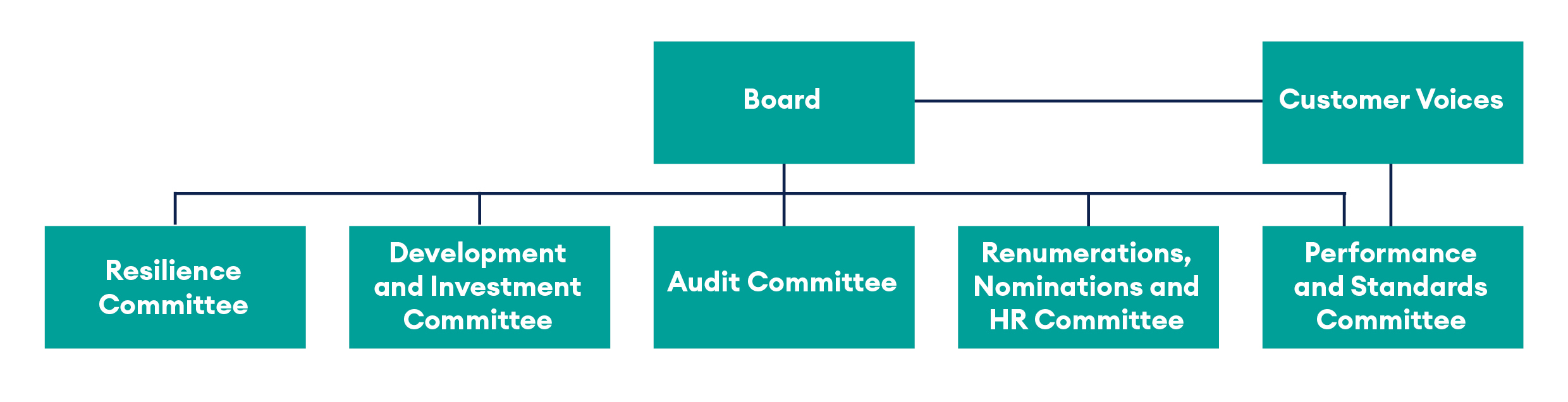
We have adopted the NHF Code of Governance 2020 to ensure our governance remains fit for purpose. Our approach reflects our value of doing the right thing for our colleagues, our customers and our business, with clear oversight and assurance for the Board, committees and the Executive Management Team.
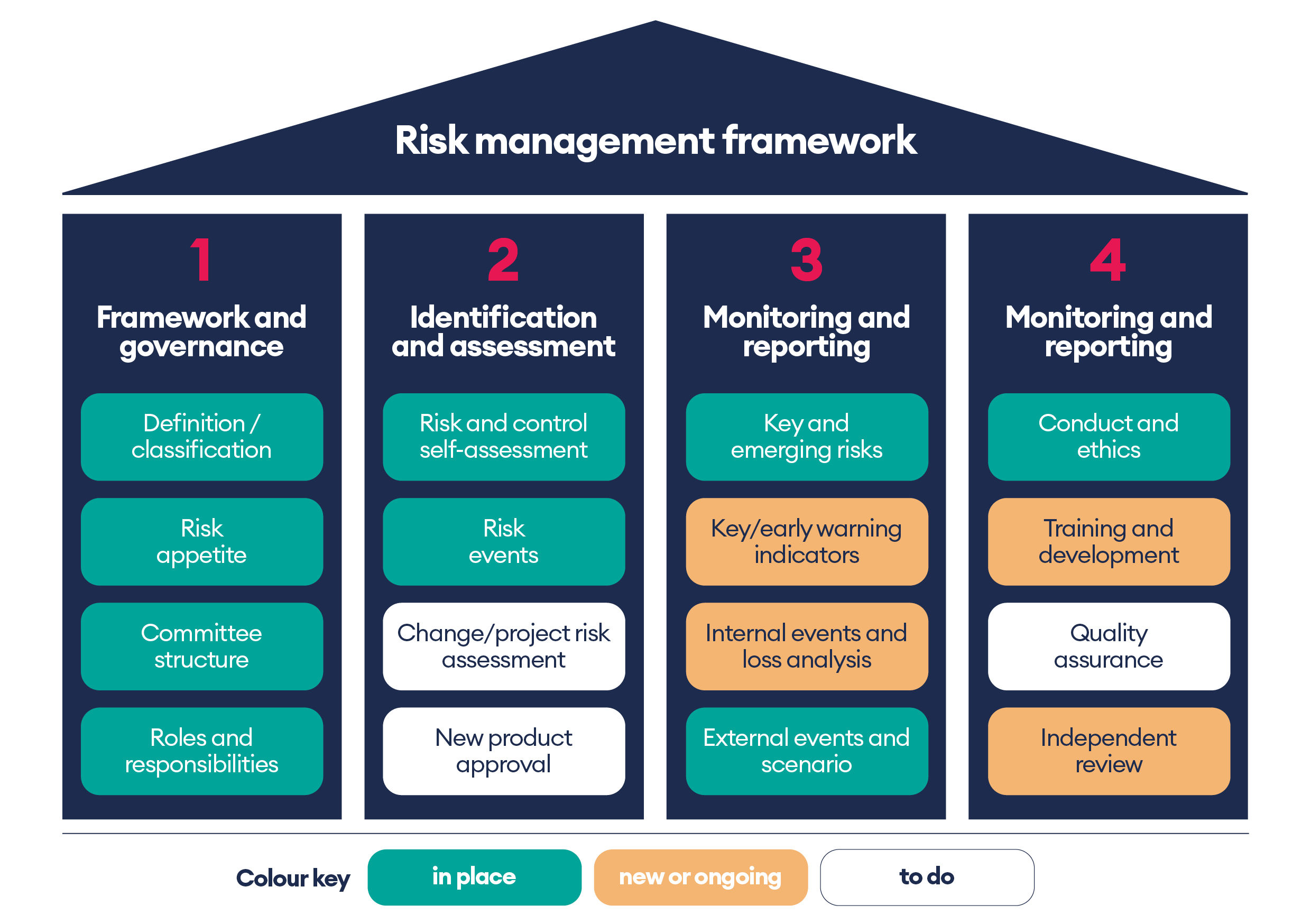
Our approach to risk is managed using a well-established risk management framework, using the four key pillars outlined in the framework below:
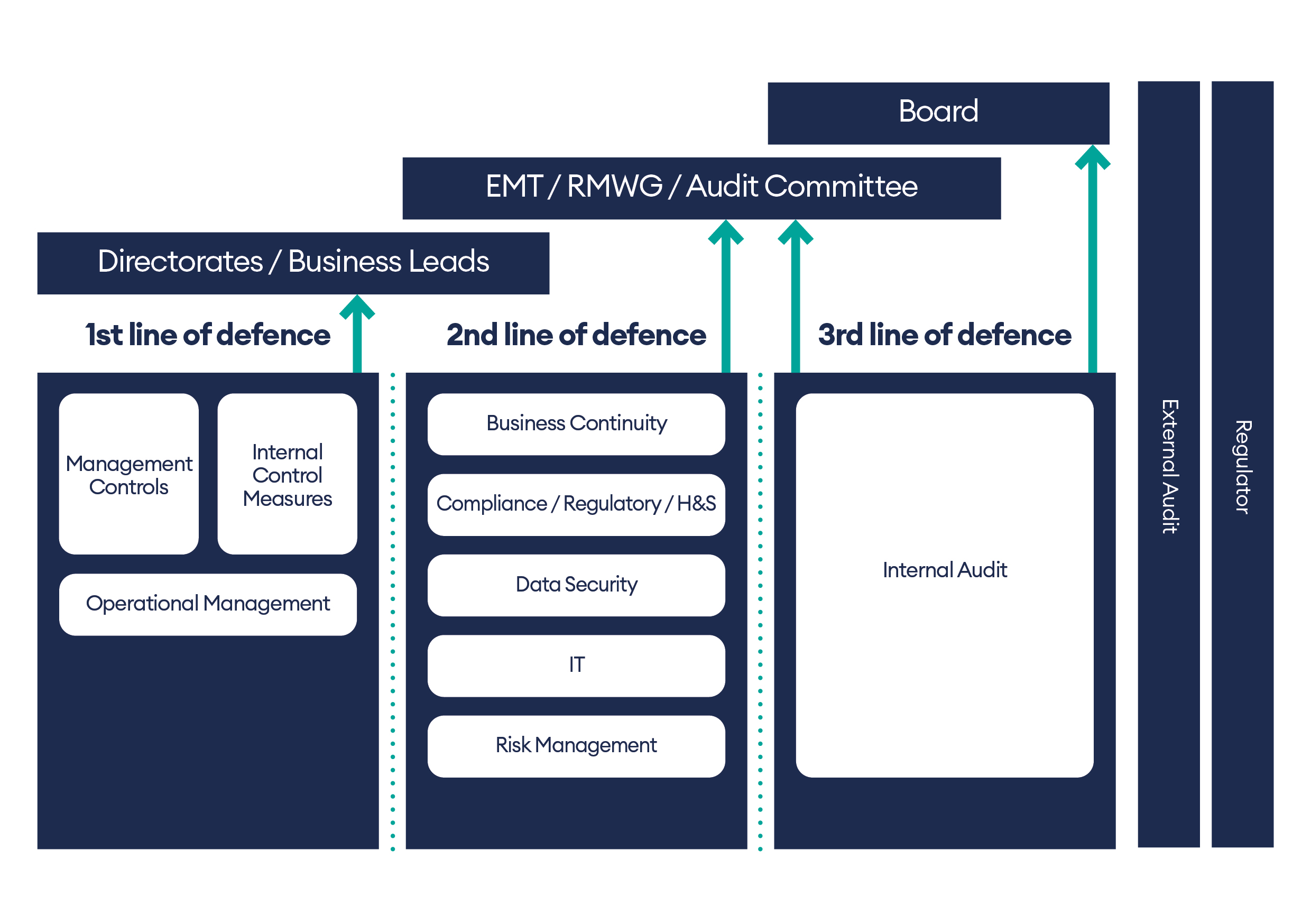
We continue to operate a ‘three lines of defence’ model. First line are the directors and managers with direct responsibility for the daily management and control of risk. Second line includes our Board, Audit Committee, Executive Management Team (EMT), Risk Management Working Group (RMWG) and specialist colleagues who oversee the effectiveness and integrity of the Risk Management Framework. The third line includes independent and objective assurance from external partners such as external audit, internal audit and technical/specialist consultants.
We regularly review risk registers and control self-assessments with risk owners, leads and the Risk Management Working Group. These reviews identify emerging external risks, agree mitigations and inform quarterly reporting to the Audit Committee and Board. The group also uses a horizon radar to assess risk exposures, including ESG risks, and identify opportunities that support proactive decision-making. The Board receives regular updates and sets the organisation’s risk appetite, providing clear parameters for risk tolerance, opportunity management and decision-making. Our current internal and external audit partners were appointed from 1 April 2025.

Board and trustees
As part of our commitment to equity, we aim to maintain a Board of Directors that reflects the communities we serve and has the skills needed to support business priorities.
Our Board Trainee Programme helps broaden Board diversity and strengthen future succession. This year, one trainee was appointed to the Board, bringing existing organisational knowledge and the ability to contribute quickly. Each recruitment campaign is determined by the skills required and aims to attract as broad a field as possible to support diversity of thought in the boardroom. A Board training and development programme is in place to further develop the individual and collective skills of the Board.
We carry out an annual review on the effectiveness of our governance arrangements, supported by an independent review every three years, most recent one taking place on 9 October 2024.
Our current Board make-up includes the following:
Board make-up
| 2023/24 | 2024/25 | 2025/26 | |
| % of Board that are women | 41.7% | 44.4% | 33.3% |
| % of Board that are BAME | 0.0% | 0.0% | 0.0% |
| % of Board that have a disability | 8.3% | 11.1% | 11.1% |
| % Board that are residents | 8.3% | 11.1% | 11.1% |
| % of Board that are LGBTQ+ | - | - | - |
| Average age of Board members (years) | 58.16 | 54.4 | 56.1 |
| Average Board tenure (years) | 3.05 | 2.77 | 4.2 |
Over the past two years, Board turnover has been 30%, with 20% turnover in the Executive Management Team. Following adoption of the NHF Code of Governance 2020, standard Board tenure reduced from nine to six years. Some Board members may serve up to nine years where this is in the organisation’s best interests, while others serve six years unless the Board approves an extension. Of the 12 current board members, two are executive directors and 10 are non-executive directors. Non-executive directors make up 81.82% of Board membership, and four Board members sit on the Audit Committee, two of whom have financial experience and expertise.
Renewal and succession policy documents aim to deliver a Board that includes people from diverse backgrounds and with diverse attributes to provide healthy debate and challenge from a range of perspectives.
Following consultation, our Customer Voices group now focuses solely on scrutiny. This change strengthens the function and gives the group more time to carry out deeper reviews, helping ensure customer voice is heard at Board level and used to support improvement and transparency.
During the year, our Engagement Team held focus groups, face-to-face sessions and community events to gather customer feedback. We continue to explore ways to reach more customers and strengthen how their views inform decisions, service delivery and ongoing improvement.
Conflicts of interest are declared annually and at the earliest opportunity when a specific issue arises. The publicly available register of interests is reported to Board each year. Declarations of Interest are also a standing item at Board and committee meetings and are recorded in the minutes.
The Chief Executive and Chair of the Board are separate roles held by different individuals. Our Chief Executive has been in post for three years, and a new Chair was appointed in October 2024. We also have a Senior Independent Director, who provides an additional route for Board members to raise concerns and supports the management of potential Board conflicts or issues.
Colleague
Colleague experience and wellbeing
Over the last 12 months, believe housing has invested in colleague development through qualifications, apprenticeships, leadership and management development, technical and compliance training, professional skills programmes and organisation-wide learning.
This includes housing qualifications through SHINE, GEM and apprenticeship routes, alongside development in project management, procurement, HR, data protection and leadership.
Management capability has been strengthened through the People Manager Essentials programme, with additional workshops on hybrid team management, coaching and conflict management. Wider learning has focused on areas such as unconscious bias, inclusive leadership, personal effectiveness and workplace behaviours. Learning at Work Week 2026 also offered workshops, TED-style talks, job shadowing and knowledge-sharing linked to competence, conduct and customer outcomes.
Mandatory and role-specific learning has also been refreshed, including personal safety, preventing workplace violence, domestic abuse awareness, recognising vulnerability, preventing sexual harassment, and compliance programmes covering health and safety, risk management and operational requirements. Innovative learning such as ‘Beyond the Doorstep’ training has supported Property Repairs colleagues to strengthen inclusion awareness, customer conversations, early intervention and safe working practices.
This activity has increased colleague confidence, capability and practical application of learning, particularly across leadership and people management. Feedback from leadership and management development has been overwhelmingly positive with satisfaction ratings above 95% and evidence of improved knowledge and competence following training.
For the wider organisation, the investment has strengthened professional standards, regulatory readiness, consistency of practice, management capability and organisational resilience. Strong mandatory learning compliance, with most modules above 95%, supports safer, more effective services and reinforces a values-led, customer-focused culture.
believe housing has continued to invest in colleague wellbeing, with support covering physical, mental and financial health. This includes Occupational Health, psychological support, clinical supervision for Urgent Support colleagues, and a healthcare cash plan with access to an Employee Assistance Programme.
Wellbeing training has also been expanded, including mental health awareness, support for line managers and menopause awareness. Line managers are further supported through the People Manager Essentials sickness absence programme, toolkit and guidance resources, promoting early intervention and consistent absence management.
These initiatives have increased awareness and use of wellbeing support, improved access to health and mental health resources, and helped colleagues receive earlier support when needed. They have also improved line manager confidence in supporting wellbeing, attendance and sensitive conversations.
For the wider organisation, this supports early intervention, attendance, engagement and productivity, while reinforcing a healthy, supportive and inclusive workplace culture.
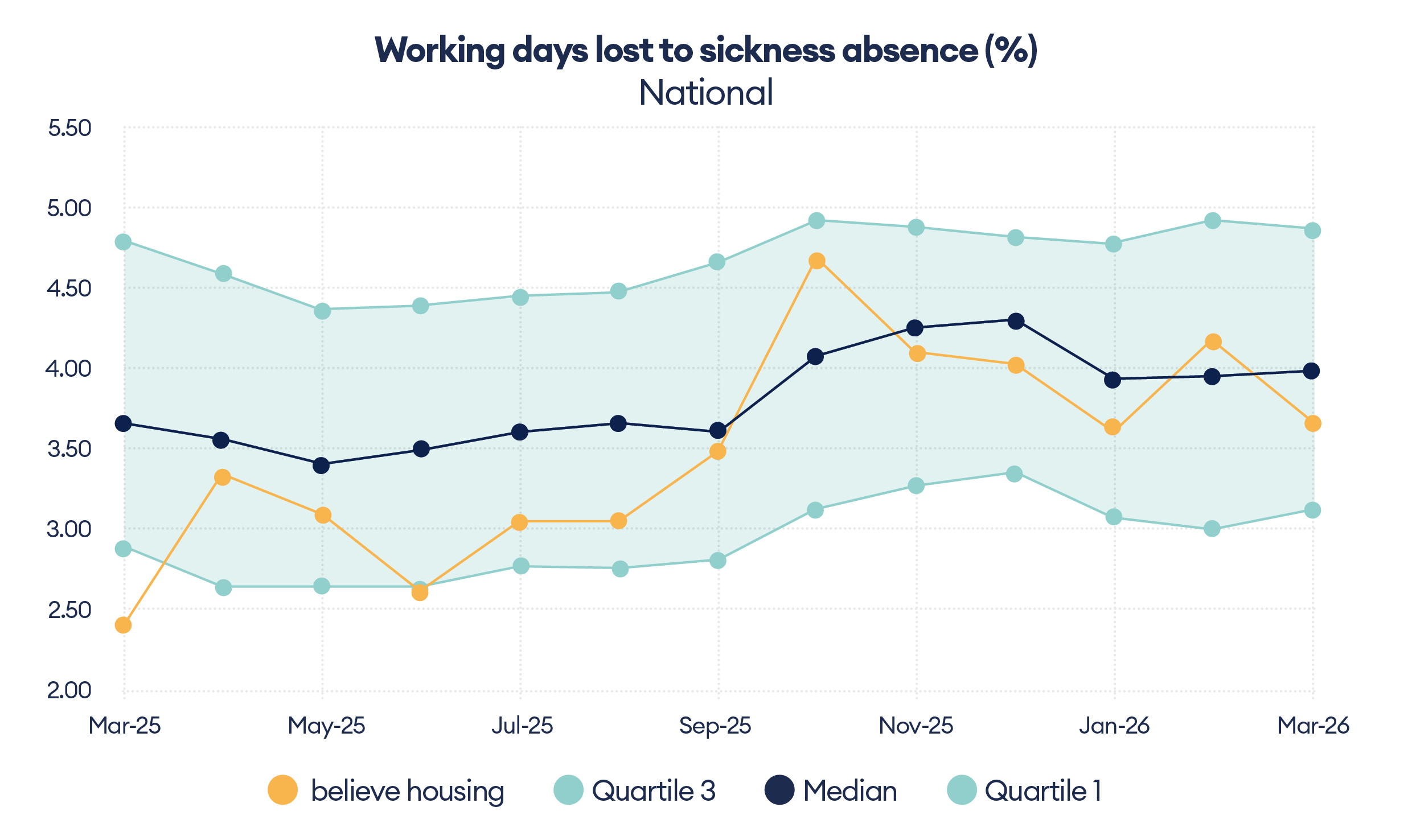
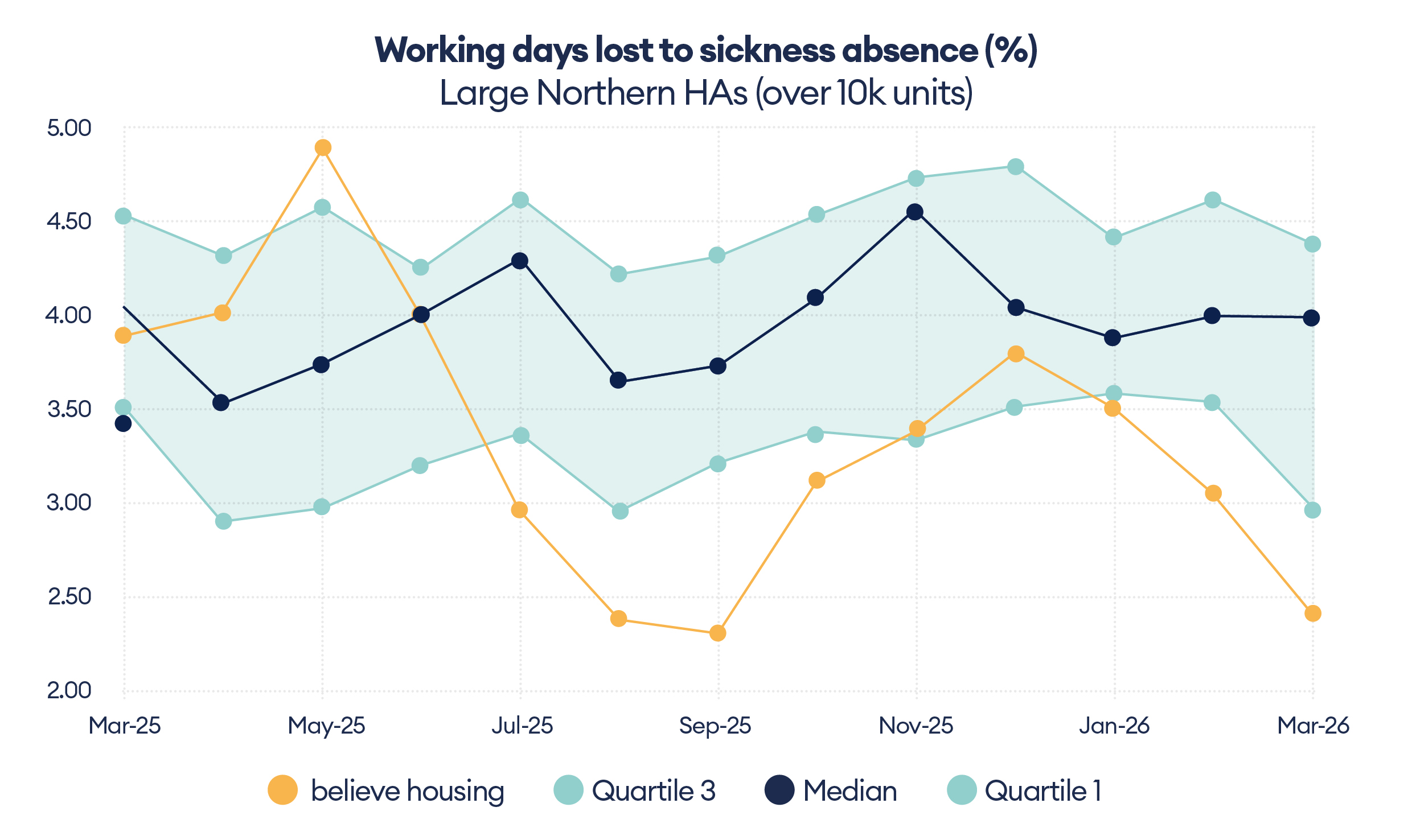
As a business, we reported the average number of sick days per employee for 2025/26 to be 8.92 days, an increase from 8.40 days last year. The graphs below show our performance regionally and nationally:
We partner with two external, independent employee assistance providers to provide support to employees in matters such as counselling, legal advice, bereavement assistance and general health and wellbeing advice, including support with family and financial issues.
We continue to pay the real living wage and continue to review the best way to reward our colleagues in a meaningful way, introducing a choice-based system where colleagues can select the benefits that best suit their circumstances. This has included the introduction of a new benefits system that gives colleagues an overview of the benefits they receive and to select additional options such as purchasing additional annual leave, while also highlighting the impact on the overall financial package.
Women continue to play an important role across believe housing and this is reflected in the reduction in our gender pay gap. Our gender pay gap information is displayed:
Gender pay gap
| Gender pay gap | 2024/25 | 2025/26 |
|---|---|---|
| % gap (mean) | 1.1% | 1.1% |
| % gap (median) | 8.1% | 6.4% |
| CEO to worker pay ratio | 5:8:1 | 5:4:1 |
The future of our ESG
Our ESG report provides vital insight into our performance in a challenging and changing social housing environment.
With growing expectations around transparency, regulation, home quality, safety, decarbonisation, affordability and financial resilience, it helps us demonstrate progress, identify where we need to improve and show how we are responding to the issues that matter most to customers, colleagues, communities and stakeholders.
As a business, we are clear about our role in creating positive social, environmental and economic impact.
Our approach to ESG reporting has evolved each year and will continue to develop so the information we share stays relevant, meaningful and aligned to the changing priorities of the sector.