

Domestic abuse policy
- 1. Purpose and scope
- 2. Policy statement and aims
- 3. Legislation and guidance
- 4. Roles and responsibilities
- 5. Statutory Definition of Domestic Abuse
- 6. Domestic Abuse Housing Alliance (DAHA)
- 7. Definitions of abuse
- 8. Barriers and challenges to ending abusive relationships
- 9. Confidentiality
- 10. Use of tools and powers
- 11. Target hardening
- 12. Housing needs
- 13. Multi-Agency Risk Assessment Conference (MARAC)
- 14. Multi-Agency Tasking and Coordinating (MATAC)
- 15. Performance monitoring and review
- 16. Training and awareness
- 17. Complaints
- 18. Useful contacts
- Appendix 1
1. Purpose and scope
Purpose
1.1 We are committed to maintaining thriving, safe communities, and we recognise that domestic abuse can have a devastating impact upon its victims.
1.2 A large proportion of believe housing staff are in regular contact with our customers, either on the telephone or in their homes and are in a position where they may be able to identify the signs of domestic abuse and offer the appropriate help. Alternatively, a customer may make a disclosure that they are the victim of domestic abuse, and our staff must be able to deal with that disclosure appropriately.
Scope
1.3 This policy outlines our approach to assisting and supporting any person experiencing domestic abuse.
1.4 We also recognise that our own staff may be experiencing domestic abuse and are committed to supporting them in any way that we can. This is addressed in a separate policy and procedure and as part of our staff support package.
This policy should be considered in conjunction with our suite of detailed procedures to support our approach.
2. Policy statement and aims
Statement
2.1 We are committed to supporting any person who is experiencing domestic abuse and will work closely with our partner agencies to ensure that the appropriate safeguards are put in place and that the victim’s rights and wishes are respected.
2.2 We recognise that the safety of the victim and their family is paramount, and we will do all we can to ensure that they are protected.
Aims
2.3 We believe that our customers should not live in fear of violence, abuse or harassment from a partner, former partner, or any member of their household or family.
2.4 Anyone reporting domestic abuse to us will be treated in a supportive and non-judgmental way. Any disclosure of abuse will be taken seriously, and advice and support will be given as a priority.
2.5 We will work with statutory and voluntary organisations to support victims and to take action against perpetrators (where this is safe and appropriate to do so).
2.6 We will:
• Ensure that anyone experiencing domestic abuse can access appropriate support as a matter of priority
• Ensure that our staff are trained to deal with disclosures of domestic abuse effectively
• Support people who are experiencing abuse, or have experienced abuse, by working in partnership with them and other support agencies
• Provide options to victims of domestic abuse so that they are empowered to make their own decisions about what they would like to happen next, and can make informed choices
• Encourage victims to report domestic abuse and reassure them that they will be supported
• Consider the impact of domestic abuse on children and young people and ensure that they too have access to services as soon as possible
• Signpost and support victims to access help with the use of civil and criminal laws, to offer them protection and to prevent further abuse
• Make appropriate safeguarding referrals if we believe that a child or a vulnerable adult is at risk due to an abusive relationship
• Signpost perpetrators of domestic abuse to agencies that can offer them support and interventions to try and prevent a recurrence of abuse
• Support victims to make decisions around their housing needs, whether they wish to remain in their home or to move to a new home
• Recognise that domestic abuse is a gendered crime and support the Violence Against Women and Girls (VAWG) agenda
• Support black and minoritised victim/survivors and our customers with protected characteristics, to access information and support.
2.7 When dealing with domestic abuse, full consideration will be given to our safeguarding responsibilities, details of which are included in our Safeguarding Children and Adults Policy.
3. Legislation and guidance
3.1 The following is a list of documents and associated policies/publications which we will consider when developing our approach to supporting victims of domestic abuse:
• Domestic Abuse Act 2021
• Housing Act 1988, 1996
• Family Law Act 1996
• Protection from Harassment Act 1997
• Human Rights Act 1998
• Data Protection Act 2018
• Domestic Violence, Crime & Victims Act 2004
• Police & Justice Act 2006
• Equality Act 2010
• Protection of Freedoms Act 2012
• Anti-Social Behaviour, Crime & Policing Act 2014
• Serious Crime Act 2015
• Care Act 2014
• Clare’s Law/Domestic Violence Disclosure Scheme (DVDS)
• National Housing Federation Document Retention Schedule 2018
• HM Government: Call to End Violence Against Women & Girls Strategy & Action Plan
• ADASS Adult Safeguarding & Domestic Abuse – Guide to Support Practitioners & Managers (2017)
• Stalking Protection Act 2019
• Domestic Abuse Act Statutory Guidance 2022.
4. Roles and responsibilities
4.1 The Assistant Director of Neighbourhoods is responsible for the implementation and review of this policy. The operational day to day delivery of the policy is the responsibility of the Tenancy Sustainment Manager and the Urgent Support Team.
4.2 All believe housing staff are responsible for reading and familiarising themselves with this policy and the associated toolkits and procedures.
5. Statutory Definition of Domestic Abuse
5.1 The Domestic Abuse Act 2021 Part 1 introduces the first statutory definition of domestic abuse:
Section 1: Definition of ‘domestic abuse’
(1) This section defines ‘domestic abuse’ for the purposes of this Act.
(2) Behaviour of a person (A) towards another person (B) is ‘domestic abuse’ if:
• (a) A and B are each aged 16 or over and are personally connected to each other,
and
• (b) the behaviour is abusive.
(3) Behaviour is ‘abusive’ if it consists of any of the following:
• (a) physical or sexual abuse
• (b) violent or threatening behaviour
• (c) controlling or coercive behaviour
• (d) economic abuse (see subsection (4))
• (e) psychological, emotional or other abuse and it does not matter whether the
behaviour consists of a single incident or a course of conduct.
(4) ‘Economic’ abuse means any behaviour that has a substantial adverse effect on B’s ability to:
• (a) acquire, use or maintain money or other property, or
• (b) obtain goods or services.
(5) For the purposes of this Act A’s behaviour may be behaviour ‘towards’ B despite the fact that it consists of conduct directed at another person (for example, B’s child).
(6) References in this Act to being abusive towards another person are to be read in accordance with this section.
(7) For the meaning of ‘personally connected’, see Section 2
Section 2: Definition of ‘personally connected’
(1) Two people are ‘personally connected’ to each other if any of the following applies:
• (a) they are, or have been, married to each other
• (b) they are, or have been, civil partners of each other
• (c) they have agreed to marry one another (whether or not the agreement has been terminated)
• (d) they have entered into a civil partnership agreement (whether or not the agreement has been terminated)
• (e) they are, or have been, in an intimate personal relationship with each other
• (f) they each have, or there has been a time when they each have had, a parental relationship in relation to the same child (see subsection (2))
• (g) they are relatives.
(2) For the purposes of subsection (1) (f) a person has a parental relationship in relation to a child if:
• (a) the person is a parent of the child, or
• (b) the person has parental responsibility for the child.
(3) In this section:
• ‘child’ means a person under the age of 18 years
• ‘civil partnership agreement’ has the meaning given by section 73 of the Civil Partnership Act 2004
• ‘parental responsibility’ has the same meaning as in the Children Act 1989
• ‘relative’ has the meaning given by section 63 (1) of the Family Law Act 1996.
Section 3: Children as victims of domestic abuse
• This section applies where behaviour of a person (‘A’) towards another person (‘B’) is domestic abuse.
• Any reference in this Act to a victim of domestic abuse includes a reference to a child who:
• (a) sees or hears, or experiences the effect of, the abuse, and
• (b) is related to A or B.
• A child is related to a person for the purposes of subsection (2) if:
• (a) the person is a parent of, or has parental responsibility for, the child, or
• (b) the child and the person are relatives
• In this section:
• ‘child’ means person under the age of 18 years
• ‘parental responsibility’ has the same meaning as in the Children Act 1989 (see section 3 of that Act)
• ‘relative’ has the meaning given by section 63 (1) of the Family Law Act 1996.
6. Domestic Abuse Housing Alliance (DAHA)
6.1 The Domestic Abuse Housing Alliance (DAHA) aim to improve the response of the housing sector to domestic abuse through the introduction and adoption of a standards of good practice, and through undertaking an accreditation process. believe housing was accredited by DAHA in 2019 and again in 2022.
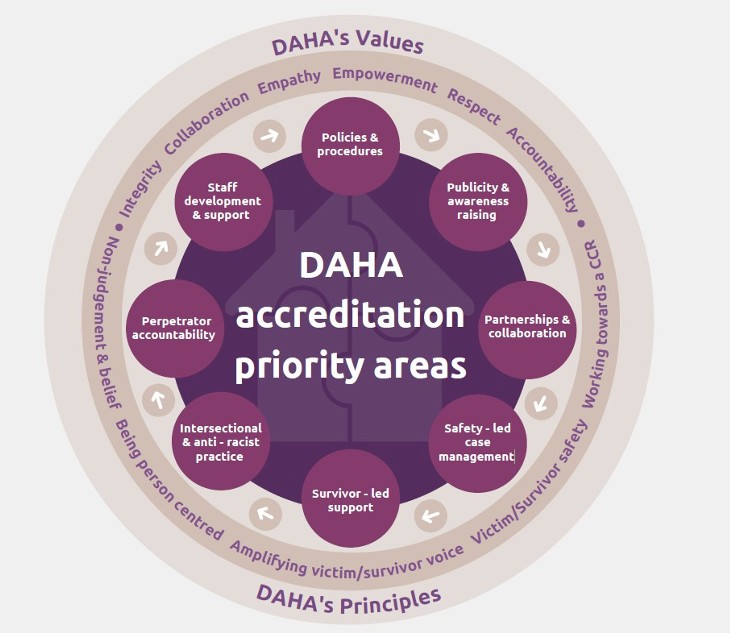
Please see Appendix 1 for details of DAHA’s values and principles, and their accreditation priority areas.
7. Definitions of abuse
Domestic abuse can take many forms, some of which are included as examples below.
Physical abuse
7.1 Physical abuse can include: hitting, punching, kicking, slapping, hitting with objects, pulling hair, pushing or shoving, cutting or stabbing, restraining, strangulation, choking.
Sexual abuse
7.2 Sexual abuse can include:
• rape and coerced sex
• forcing a victim to take part in unwanted sexual acts
• refusal to practice safe sex or use contraception
• threatened or actual sexual abuse of children.
Technological abuse
7.3 Perpetrators can use technology or social media as a means of controlling or coercing victims. This could include:
• using social media to harass the victim
• controlling emails or social media accounts
• use of spyware such as tracking apps or hidden cameras
• using home assistants such as Alexa or Google Home to monitor someone’s movements.
Economic abuse
7.4 Economic abuse can include:
• controlling money and bank accounts
• making a victim account for all of their expenditure
• running up debts in the victim’s name
• allowing the victim, no say on how their monies are spent
• refusing to allow them to work.
Where rent arrears have accrued as a result of economic abuse, including debt linked to domestic or financial abuse, believe housing will ensure this is considered on a case-by-case basis. We will take time to understand the customer’s circumstances and will take this into account when considering any action or next steps. We will also offer advice, support and signposting to help customers access the assistance they need.
Psychological and emotional abuse
7.5 Psychological and emotional abuse can have a profound impact on victims. It can leave them with little confidence that they can do anything to change their situation, or that they are powerless to take any action to improve their lives, or the lives of their children.
Examples include:
• Isolating the victim – not allowing them to see their friends or family, or to go anywhere on their own
• Using threats – threats to kill their family, children, friends, or pets, or to find them if they were ever to try and leave
• Putting them down – humiliating, embarrassing or undermining them in front of others, telling them that they are stupid and that no one would believe them if they tried to tell people what was happening, or that they are a bad parent.
Family and intergenerational abuse
7.6 Domestic abuse approaches historically have had an emphasis on partner violence. More focus is now being given to family and intergenerational abuse, and the way in which it may be different from partner violence; for instance, if the perpetrator is the victim’s (adult) sibling, child or grandchild.
Abuse of an adult or a child may also be used by a perpetrator to exercise control over their victim.
Coercive and controlling behaviour
7.7 Controlling and coercive behaviour is defined by Section 77 of the Serious Crime Act 2015, as:
• a range of acts designed to make a person subordinate and/or dependent by isolating them from sources of support, exploiting their resources for personal gain, depriving them of the means needed for independence, resistance and escape and regulating their everyday behaviour.
• Coercive behaviour is an act or a pattern of acts of assault, threats, humiliation and intimidation or other abuse that is used to harm, punish, or frighten their victim.
This could include:
• Controlling who they see, or what they wear
• Controlling their medication, or preventing them from seeing medical professionals such as doctors or dentists
• Isolating them from friends, family or other means of support
• emotional or psychological abuse
• economic abuse
So-called honour-based violence and abuse
7.8 So-called honour-based abuse includes offences that may have been committed to protect the perceived honour of a family or a community and can incorporate many of the types of abuse detailed above. It is often carried out by family members, but victims can also come under pressure from the wider community who will seek to support the family in their actions. So-called honour-based violence and abuse can also include:
• forced marriage
• female genital mutilation.
8. Barriers and challenges to ending abusive relationships
8.1 We recognise that victims will often find it extremely difficult to make a disclosure and ask for help. It is vitally important, therefore, that if a disclosure is made, it is dealt with in a sensitive and supportive manner.
Staff are provided with guidance on how to deal with a disclosure and ensure that all appropriate advice, support and safeguarding is carried out.
It is important to understand that victims may not seek, or respond to, offers of help and may wish to remain in their abusive relationship. Reasons for this may include:
• Fear of the abuser and/or what they will do
• Doubt about the impact of any action taken by police or the courts, and fear of pressure to pursue a criminal case
• Lack of knowledge/access to support services
• Lack of resources, financial or otherwise
• Fear of not being believed
• Love, loyalty, attachment towards their partner and the hope that they will change
• Feelings of shame or failure
• Pressure from family/children/friends
• Religious or cultural expectations
• Long-term effects of abuse, such as self-neglect, depression, low self esteem
• Drug and/or alcohol addiction
• Anticipated impact on children, or fear of losing contact with children/other relatives/friends.
8.2 People from black and minoritised communities may also have additional barriers, including:
• Language barriers
• Perceived family honour, shame or stigma
• Fear of rejection by their community
• Immigration status/no recourse to public funding
• Racism (perceived or actual)
• Cultural or community expectations
• Fear of so-called honour-based violence
• Lack of appropriate services.
8.3 People with disabilities are more likely to experience domestic abuse, and more likely to be at high risk of serious harm. Barriers to disabled people accessing services can include:
• Lack of accessible information about abuse and legal rights
• Lack of accessible domestic abuse services
• Fear that interpreters (for example, British Sign Language) may not keep confidentiality
• Assumptions that physical and sensory impairments prevent people from making their own decisions
• Being used to ‘dependency’ and a lack of respect and dignity, leading to them assuming that abuse is normal and minimising its impact
• Fear of having to live in a care home
• Reliance on the abuser for care and support
• The victim may be the carer of the abuser, and feel a sense of obligation to maintain the support and endure the abuse
• The abuser may be the only person with whom the victim has any contact.
9. Confidentiality
9.1 Data sharing with police, local authority and other partners is governed by the Data Protection Act 2018, and we will agree data sharing protocols with them.
9.2 While we respect privacy and confidentiality and are mindful of our obligations under the Data Protection Act, investigating and preventing domestic abuse requires the ability to exchange information with statutory and non-statutory agencies.
9.3 A disclosure of domestic abuse will be treated in the strictest of confidence, unless we have a duty to disclose information in order to:
• Protect the victim
• Prevent harm to someone else, or
• Prevent or detect a crime.
10. Use of tools and powers
10.1 Every case of domestic abuse is different, and will be handled differently, taking into account the wishes and needs of the victim, the severity of the abuse, and any additional criminality.
10.2 Domestic abuse is a clear breach of Sections 23 and 24 of believe housing’s Tenancy Agreement.
10.3 We will make use of appropriate tools and powers to sanction those who are perpetrators of domestic abuse, including injunctions, Notice of Seeking Possession, and possession proceedings.
10.4 We will also make use of these tools and powers to help perpetrators of domestic abuse to access specialist support if they acknowledge their behaviour, want to change and consent to a referral being made.
10.5 It must be remembered that not every victim will want to end their relationship or will want us to take enforcement action against the perpetrator. It is important, therefore, to manage risk, ensure that as many safeguards are in place as possible, and to provide the victim with options as to what support is available to them, if and when they are ready to take it.
10.6 As well as the tools and powers available to us as a landlord, we will also work closely with partners to ensure a holistic approach to tackling domestic abuse and that the tools and powers available to these partner agencies are fully considered. Where appropriate we will assist these agencies and contribute to them obtaining orders that reduce domestic abuse.
11. Target hardening
11.1 Where appropriate, housing requirements and options will be discussed with every person experiencing domestic abuse. Officers will make every effort to ensure that a safe environment is provided for them and their families and will work alongside specialist
agencies to provide advice and assistance.
11.2 Our staff can provide victims with some small items of personal security equipment such as personal alarms, window and door alarms, straight away in order to try and provide some reassurance and peace of mind. We will also consider carrying out further works
such as dusk until dawn lights, lockable letterplates, safety film or additional door or window locks if required.
11.3 believe housing will also make referrals to partner agencies such as the police, fire service or local authority for additional security where appropriate and necessary.
11.4 believe housing will not require crime reference numbers where customers require lock changes or repairs as a result of domestic abuse.
12. Housing needs
12.1 A person experiencing domestic abuse may be able to remain in their own home, if it is safe to do so. However, there may be occasions where temporary accommodation is required while safety measures are being put in place.
12.2 We will consider all options where the need for a temporary or permanent move is required and will liaise with the local authority if accommodation cannot be secured straight away within believe housing’s own stock.
12.3 We will also check the tenancy status of the victim and perpetrator to identify whether tenancies are held jointly or solely. Independent legal advice may be required where victims and perpetrators hold a joint tenancy, or where a tenancy is held in a perpetrator’s sole name.
12.4 We recognise that domestic abuse, including financial or economic abuse, may result in rent arrears or other debt. Where debt is linked to abuse, this will not automatically prevent access to housing or support for applicants or customers. Each case will be considered individually and, where appropriate, support and signposting to specialist advice services will be offered.
13. Multi-Agency Risk Assessment Conference (MARAC)
13.1 High risk domestic abuse cases are heard at regular Multi-Agency Risk Assessment Conferences (MARAC), which are attended by an appropriate member of staff from believe housing, alongside representatives from other services including health services, police, domestic abuse support services and appropriate officers from the local authority.
All meetings are confidential. Information is shared and action plans agreed to safeguard the victim and their family, and to ensure that appropriate measures are put in place for the perpetrator.
13.2 Referrals to MARAC will be made after discussion with, and consent from, the victim.
However, if consent is not granted and there is an immediate or potential risk to the victim or the victim’s family, a referral may be made without the consent of the victim to protect them and their family from potentially serious harm.
13.3 Representatives from both Child and Adult Services attend all MARAC meetings. The MARAC Chair may direct that a safeguarding referral be made, if services are not already involved and it is felt that immediate action is needed to protect either a vulnerable adult, or
any children living in an abusive household. Safeguarding investigations will take place outside of the MARAC process, but partner agencies will remain involved, where appropriate, to ensure that relevant information is shared, and concerns are acted upon.
14. Multi-Agency Tasking and Coordinating (MATAC)
14.1 MATAC meetings discuss those couples/families that include repeat perpetrators or victims, and who are deemed to be of medium risk. These are attended by multi-agencies including police, housing, local authority and specialist support agencies. Dedicated officers carry out
interventions and support with all parties with the aim of breaking the cycle of abuse and tackling the cause of the abusive behaviour.
15. Performance monitoring and review
Monitoring
15.1 There is a separate Domestic Abuse Procedure which provides staff with further detail and guidance on how to deal with reports or disclosures of domestic abuse.
15.2 The number of reported domestic abuse cases is monitored on a monthly and quarterly basis. We also, where appropriate and safe to do so, ask for feedback from customers on how they felt their concerns were dealt with.
15.3 Feedback and analysis will be used to identify any trends and to continuously improve service delivery.
15.4 We also monitor the number of customers supported with target hardening or additional security measures and liaise with police to identify any new or improved equipment that may enhance the offer we provide.
15.5 Procedures are also regularly reviewed to take into account any good practice, or any changes in legislation.
Review
15.6 This policy will be reviewed every three years, or due to:
• Changes in relevant legislation
• Any issues raised about the policy by an independent organisation (such as an inspection) which then, in the opinion of believe housing, would require a review of this policy.
16. Training and awareness
16.1 Our staff will receive regular training on domestic abuse, including how to identify the signs of abuse and how to deal appropriately with a disclosure.
16.2 All staff will be given regular safeguarding training and will be updated on any changes to policy, procedure or legislation around domestic abuse and safeguarding.
16.3 believe housing will also support any staff member adversely affected by dealing with any incidents of domestic abuse as part of our approach to staff welfare.
17. Complaints
17.1 If a customer is unhappy about the service they have received from us they can make a complaint. The complaint should be made to believe housing in the first instance, or alternatively seeking advice from the Housing Ombudsman before doing so. Please see believe housing Complaints, Compliments and Compensation Policy for further details.
18. Useful contacts
• believe housing – www.believehousing.co.uk or email urgentsupportteam@believehousing.co.uk
• Police – telephone 101 (non-emergency) or 999 (emergency)
• Housing Solutions Durham County Council – www.durham.gov.uk or telephone 08081 968406
• Housing Advice Sunderland City Council – www.sunderland.gov.uk or telephone 0800 2346084
• Homelessness and Housing Solutions Service Stockton Borough Council – www.stockton.gov.uk or telephone 01642 528389 (out of hours 01642 524552)
• Harbour – www.myharbour.org.uk or telephone 0300 020 2525 (24 hours)
• Wear Valley Women’s Aid – www.wvwa.co.uk or telephone 01388 600094
• National Domestic Violence helpline – www.nationaldahelpline.org.uk or telephone 0808 200 0247
• Hourglass, specialist support for older people – www.wearehourglass.org or telephone 0808 8088141
• ManKind – helping men escape domestic abuse – www.mankind.org.uk or telephone 01823 334244
• Halo Project – supporting victims of forced marriage and honour based violence – www.haloproject.org.uk or telephone 01642 683045
• Galop – Supporting LGBTQ+ people who have experienced abuse and violence – www.galop.org.uk or telephone 0800 999 5428
• SignHealth – specialise in providing domestic abuse support for deaf people – www.signhealth.org.uk
• The Traveller Movement – providing information and support for Gypsy, Roma and Traveller women – women@travellermovement.org.uk
Appendix 1
DAHA’s Values, Principles and priority areas
This policy was reviewed and updated in January 2024.